Highlights:
- Don't choose a personal loan just because the money is available quickly. Check the interest rate, fees, EMI, and total repayment first.
- Borrow only what you need and make sure the EMI fits comfortably into your monthly budget.
- Multiple loan applications, missed EMIs, and high existing debt can affect your credit profile, so plan your borrowing before you apply.
You need ₹50,000 for an unexpected expense. You find a personal loan online, see that the application takes only a few minutes, and think, “Why not?”
But getting a loan is only one part of the decision.
The bigger question is: Can you afford it, and do you know what you're actually paying for?
A personal loan can be useful when you have a genuine financial need. But small mistakes while choosing or repaying one can make the loan more expensive than expected.
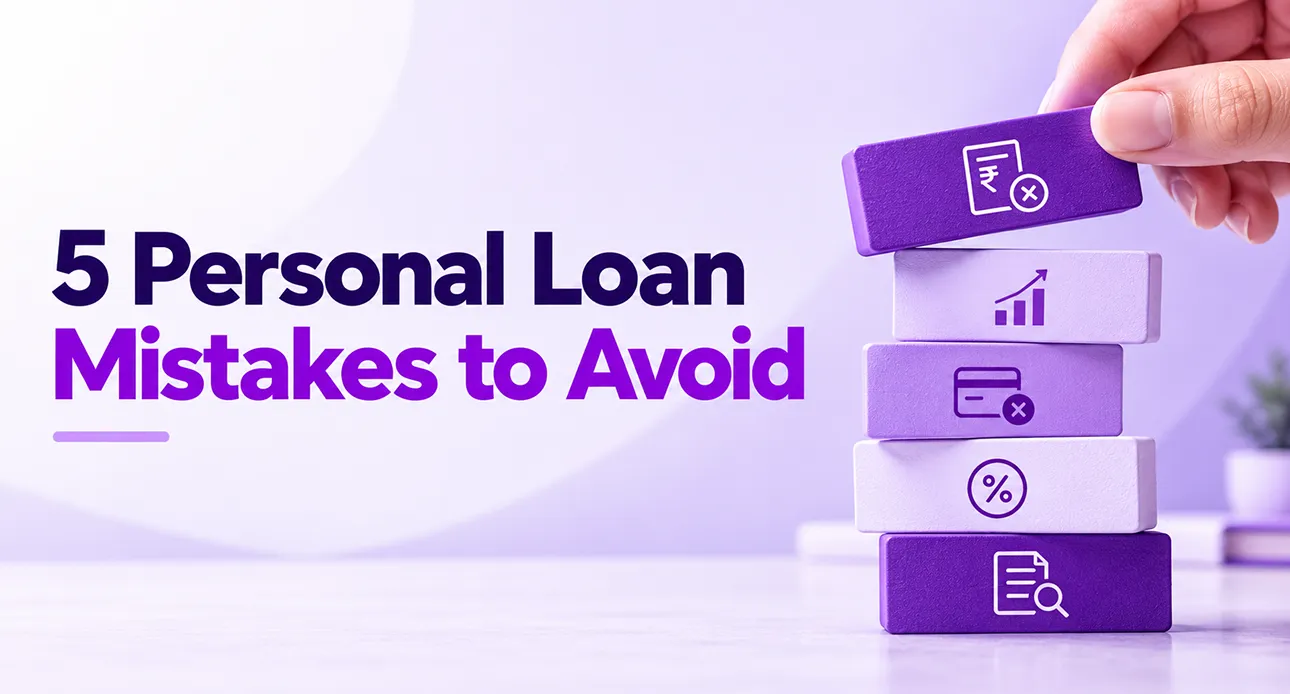
So, before you start the personal loan application process, let's look at five common mistakes borrowers should avoid. Read this blog before you say yes to your next personal loan.
What Is a Personal Loan?
A personal loan is generally an unsecured loan, which means you don't usually have to pledge an asset such as a house or vehicle as collateral.
The lender decides the loan amount, interest rate, and repayment terms based on factors such as your income, credit history, existing obligations, and its lending policy.
You usually repay the loan through monthly EMIs over a fixed tenure.
Now let's get to the mistakes that can make borrowing unnecessarily expensive.
Mistake 1: Applying Without Checking the Complete Cost
Seeing a line such as “Personal loan at a low interest rate” can be tempting. But the interest rate isn't the only number that matters.
A loan can also have processing fees, documentation charges, late-payment charges, and other applicable costs.
For example, imagine you borrow ₹1,00,000 at 18% per annum for 12 months. Your EMI would be around ₹9,168, and the total interest would be roughly ₹10,016, before any applicable fees.
Now add a processing fee, GST, or other charges, and your actual borrowing cost can be higher.
What to do instead
Before completing the personal loan application process, check:
- Interest rate
- APR, where disclosed
- Processing fee
- GST and other applicable charges
- Late-payment charges
- Prepayment or foreclosure terms
- Total repayment amount
Don't compare loans only by the interest rate. Compare the total cost.
Mistake 2: Borrowing More Than You Need
A lender offering ₹2 lakh doesn't mean you need to borrow ₹2 lakh.
Suppose you actually need ₹60,000 but take ₹1,00,000 because the additional amount is available. You now have to repay interest and other applicable charges on money you didn't really need.
The higher the principal, the higher the repayment burden can become.
What to do instead
Start with one simple question:
“How much do I actually need?”
List the expense, calculate the amount required, and borrow only what you can reasonably repay.
A personal loan should solve a financial requirement, not create another one.
Mistake 3: Choosing an EMI That Stretches Your Budget
A lower EMI can look attractive because it leaves more money in your account every month.
But there's a catch: choosing a longer tenure can mean paying interest for a longer period.
Consider a hypothetical ₹2 lakh loan at 18% per annum:
| Tenure | Approx. EMI | Approx. total repayment |
| 12 months | ₹18,336 | ₹2.20 lakh |
| 24 months | ₹9,985 | ₹2.40 lakh |
| 36 months | ₹7,230 | ₹2.60 lakh |
Illustration only. Actual EMI and total repayment depend on the lender's rate and applicable charges.
The 36-month option has a much smaller EMI, but the overall repayment is higher.
What to do instead
Use a personal loan EMI calculator before applying.
Try different loan amounts and tenures and ask yourself:
“Can I comfortably pay this EMI every month, even if another expense comes up?”
Mistake 4: Ignoring the Fine Print and Extra Charges
The number you see in an advertisement may not tell you the complete story.
Processing fees, late-payment charges, prepayment conditions, and other applicable fees can affect the final cost of your personal loan.
For digital lending, RBI's framework requires borrowers to receive important loan information, including the Key Fact Statement (KFS) and Annual Percentage Rate (APR), helping them understand the overall cost of credit.
What to do instead
Before accepting the loan, read the KFS and loan agreement.
Look specifically for:
- Processing fee
- Applicable taxes
- Penal charges
- Prepayment or foreclosure conditions
- Repayment schedule
- Total amount payable
If a charge isn't clear, ask the lender before accepting the loan.
Mistake 5: Applying for Multiple Loans Just to Improve Your Chances
When one application gets rejected, it can be tempting to immediately try another lender. Then another.
But repeatedly applying for credit within a short period can result in multiple hard enquiries on your credit report. CIBIL notes that multiple credit applications or enquiries in a short period may impact your credit score.
However, a loan rejection itself does not automatically mean your CIBIL score will fall. The credit enquiry associated with an application is what can affect your credit profile.
What to do instead
Before you apply:
- Check your credit report.
- Understand the lender's eligibility criteria.
- Check your existing EMIs and outstanding dues.
- Apply only when the loan fits your financial situation.
This can help you avoid unnecessary credit enquiries.
A Simple Checklist Before You Take a Personal Loan
Before you complete your personal loan application process, take two minutes to check these numbers:
| What to check | Why it matters |
| Loan amount | Determines how much you need to repay |
| Interest rate | Affects your interest cost |
| EMI | Shows your monthly repayment |
| Tenure | Affects EMI and total interest |
| Processing fee | Adds to borrowing cost |
| Total repayment | Shows the bigger picture |
| Credit enquiries | Multiple enquiries can affect your credit profile |
If you understand these seven things, you are already making a more informed borrowing decision.
When Can a Personal Loan Make Sense?
A personal loan may be useful when you have a specific, planned financial requirement and a clear repayment plan.
For example, you may consider one for an important expense such as a planned home repair, education-related cost, medical expense, or debt consolidation, depending on your financial situation and the lender's terms.
But borrowing simply because you are eligible for a higher amount can turn convenient credit into unnecessary debt.
Conclusion
Taking a personal loan doesn't have to be complicated.
The mistake is usually not in taking the loan itself. It is in taking the wrong amount, choosing an unsuitable tenure, ignoring charges, or applying without checking whether you can comfortably repay it.
Before you start the personal loan application process, look beyond the headline interest rate. Calculate the EMI, check the total repayment, read the KFS, and understand every applicable charge.
And most importantly, borrow only what you need and what your monthly budget can handle.
A few minutes of checking today can save you from months of unnecessary financial pressure tomorrow.
FAQs
1. What should I check before taking a personal loan?
Check the interest rate, EMI, loan tenure, processing fee, other applicable charges, total repayment amount, and prepayment terms before accepting the loan.
2. How much personal loan should I take?
Borrow only the amount you actually need and can comfortably repay. A higher loan amount means a higher repayment burden.
3. Does applying for multiple personal loans affect my CIBIL score?
Multiple loan applications in a short period can lead to several hard enquiries on your credit report, which may affect your CIBIL score.
4. Is a lower EMI always better when taking a personal loan?
Not necessarily. A lower EMI may come with a longer repayment tenure, which can increase the total interest you pay over the loan period.
5. What is the best way to calculate personal loan repayment?
Use a personal loan EMI calculator to compare different loan amounts and tenures. Also check the total repayment and applicable fees before choosing a loan.