Highlights
- Ever wondered how people went from exchanging wheat to scanning QR codes? Explore the fascinating journey of money.
- What's really happening behind every rupee? Uncover how banks, credit and money markets keep money moving.
- From cash in hand to payments in a tap, discover how UPI and the Digital Rupee are shaping India's financial future.
The journey of money is more interesting than you might think.
Today, you can buy groceries, pay rent, book a cab and transfer money with a few taps on your phone. No cash, no coins and sometimes not even a physical card!
But things were very different thousands of years ago.
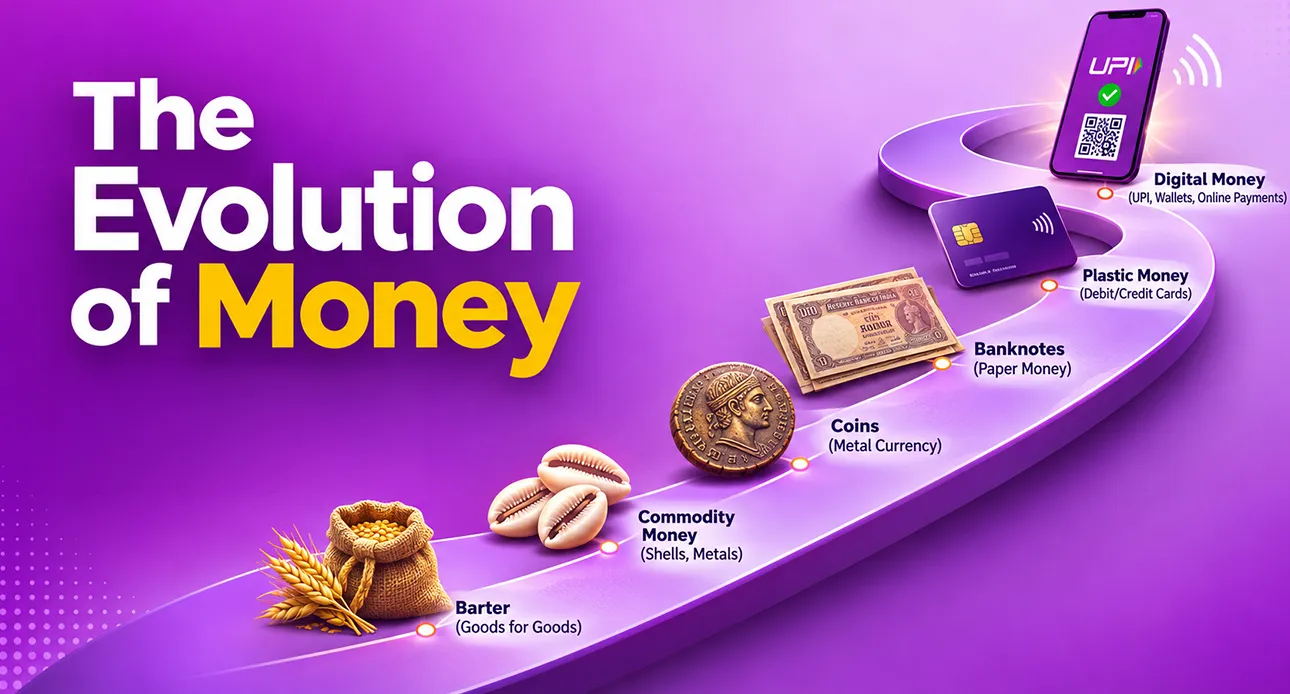
People exchanged goods to get what they needed. Over time, coins, paper currency, bank accounts and digital payments transformed how money moved.
So, how did this transformation happen? Let's explore the evolution of money and understand how it shaped the financial world we live in today.
1. Barter System: When Goods Were Money
Before money existed, people exchanged goods and services directly. This was called the barter system.
For example:
- A farmer exchanged wheat for clothes.
- A potter exchanged pots for grains.
- A cattle owner exchanged livestock for farming tools.
However, barter had a major limitation: the double coincidence of wants.
Imagine having wheat but needing clothes. You would have to find someone who had clothes and wanted wheat in return!
Other challenges included:
- No standard way to measure value.
- Difficulty storing perishable goods.
- Problems dividing certain items into smaller quantities.
- Time-consuming exchanges.
As trade expanded, people needed a more convenient way to exchange value.
2. Commodity Money and Metal Coins
People gradually began using commonly accepted goods such as gold, silver, salt, cattle and cowrie shells as money.
This was known as commodity money.
However, commodities were not always easy to carry, divide or store.
Metal coins offered a more standardised alternative.
Some of the earliest known coins appeared in Lydia, around the 7th century BCE. Ancient India also used punch-marked coins.
Why were coins important?
They provided standardised denominations.
They made trade easier.
They were easier to carry than many commodities.
They allowed people to save wealth for future use.
3. Paper Money: Making Payments Easier
Carrying bags of coins for large transactions was inconvenient.
Paper money offered a lighter and more practical alternative. China developed some of the earliest documented government-issued paper currency.
In India, the Reserve Bank of India (RBI) was established on 1 April 1935. It was nationalised in 1949 and became fully owned by the Government of India.
Today, the RBI manages currency issuance and plays a central role in India's monetary system.
Modern currency is largely fiat money. Its value depends on legal recognition, public confidence and trust in the monetary system, rather than direct conversion into gold.
4. Bank Money and Credit Money
Have you ever wondered how your salary reaches your bank account without anyone handing you cash?
That's where bank money comes in.
Bank money refers to funds held in bank accounts that can be used for payments.
Credit money arises through credit relationships and financial claims. One important example is bank deposits created when commercial banks provide loans.
For example, if a bank approves a personal loan of ₹2 lakh and credits it to your account, you can use that deposit to make payments.
The bank records:
- A loan asset of ₹2 lakh.
- A deposit liability of ₹2 lakh.
This is one way commercial banks create deposit money.
Credit also helps individuals manage expenses and businesses fund expansion. However, borrowers must understand interest rates, repayment schedules and additional charges.
5. Functions of Money: Why Does Money Matter?
Money does more than help us shop. It performs four important economic functions.
- Medium of exchange: Helps people buy and sell goods without exchanging products directly.
- Unit of account: Provides a common measure for comparing prices. For example, a ₹100 meal and an ₹800 shirt.
- Store of value: Allows people to save money for future expenses. However, inflation can reduce its purchasing power.
- Standard of deferred payment: Makes future payments possible through loans, EMIs and other credit arrangements.
These functions make money essential for individuals, businesses and the wider economy.
6. Demand for Money: Why Do People Hold Cash?
Ever divided your salary between rent, groceries, savings and emergency expenses?
That is connected to the economic concept of demand for money.
It refers to the amount of money people and businesses prefer to hold in liquid form.
Economist John Maynard Keynes identified three motives:
- Transaction motive: Money for everyday expenses such as food, rent and bills.
- Precautionary motive: Money kept aside for unexpected expenses and emergencies.
- Speculative motive: Money held temporarily while waiting for suitable investment opportunities.
Income, inflation, interest rates and economic uncertainty can influence how much money people want to hold.
7. Money Market Instruments: Where Short-Term Finance Happens
Money is also important beyond everyday purchases.
Banks, companies and governments need short-term funds to manage their financial requirements. This is where the money market plays a role.
Money market instruments generally have an original maturity of up to one year.
Important Indian money market instruments include:
| Instrument | Purpose |
| Treasury Bills | Short-term government borrowing |
| Commercial Paper | Unsecured short-term corporate borrowing |
| Certificate of Deposit | Short-term funds raised by eligible banks and financial institutions |
| Call Money | Overnight unsecured borrowing and lending |
| Repo | Borrowing against securities with an agreement to repurchase them |
For example, Treasury Bills are issued at a discount and redeemed at face value. Common maturities in India are 91, 182 and 364 days.
These instruments help financial institutions manage liquidity and businesses meet short-term funding requirements.
8. Digital Payments: The Rise of UPI in India
Remember when transferring money meant visiting a bank or filling out forms?
Technology changed that experience.
Some important milestones in India's payment journey include:
2004: RTGS was introduced.
2005: NEFT became operational.
2010: IMPS was publicly launched.
2016: UPI was launched.
2022: RBI launched its retail Digital Rupee pilot.
UPI, developed by NPCI, made everyday digital payments significantly easier.
You can now transfer money, scan QR codes and pay merchants directly through linked bank accounts.
UPI by the Numbers
According to the Ministry of Finance, UPI recorded:
24,161.69 crore transactions in FY 2025–26.
₹314 lakh crore in transaction value.
30% year-on-year growth in transaction volume.
703 participating banks as of March 2026.
For perspective, UPI recorded just 1.78 crore transactions in FY 2016–17.
That's nearly a 13,000-fold increase in annual transaction volume!
Source: Ministry of Finance, Government of India.
9. Digital Rupee: The Next Chapter of Money
If UPI already makes digital payments possible, why do we need the Digital Rupee?
Because they serve different purposes.
The Digital Rupee (e₹) is India's Central Bank Digital Currency (CBDC), issued by the RBI.
- It is the digital form of the Indian Rupee.
- It is issued by the central bank.
- It is held in digital wallets.
- It can be used for person-to-person and merchant payments.
The RBI launched its retail CBDC pilot on 1 December 2022.
Here's the key difference:
- UPI: A payment system that transfers money between bank accounts.
- Digital Rupee: A digital form of central bank-issued currency.
The RBI's October 2026 FAQs confirm that retail and wholesale CBDC arrangements continue as pilots.
Source: RBI Digital Rupee FAQs.
10. What Does the Future of Money Hold?
From barter to digital currency, money has constantly adapted to changing financial needs.
Some developments to watch include:
- Central Bank Digital Currencies.
- Faster cross-border payments.
- AI-powered fraud detection.
- Blockchain-based financial services.
- Greater access to digital banking.
However, convenience must go hand in hand with security, privacy and financial awareness.
The Bottom Line
Money has changed its form, but its purpose remains the same: making transactions, trade and economic activity easier.
The next time you scan a QR code to pay for coffee, remember that you're participating in a financial system that has evolved over thousands of years.
And its next chapter is already unfolding!
Frequently Asked Questions (FAQs)
1. What is the evolution of money?
It refers to the development of money from barter and commodity exchanges to coins, paper currency, bank deposits and digital payments.
2. What are the four functions of money?
Medium of exchange, unit of account, store of value and standard of deferred payment.
3. What is credit money?
Credit money arises through credit relationships. Bank deposits created through lending are an important example.
4. What are money market instruments?
They are short-term financial instruments, generally with an original maturity of up to one year. Examples include Treasury Bills, Commercial Paper and Certificates of Deposit.
5. Is UPI a digital currency?
No. UPI is a payment system that facilitates bank-account transfers. It is not a separate currency.
6. What is India's Digital Rupee?
It is a digital form of the Indian Rupee issued by the RBI as a Central Bank Digital Currency.
7. Will digital payments replace cash?
Not necessarily. Cash remains useful for accessibility, offline transactions and people who prefer physical payments. Both forms can coexist.